The Museum Beneath Manhattan
Text by Ashley Gabriela
Thursday, 8:21 a.m.
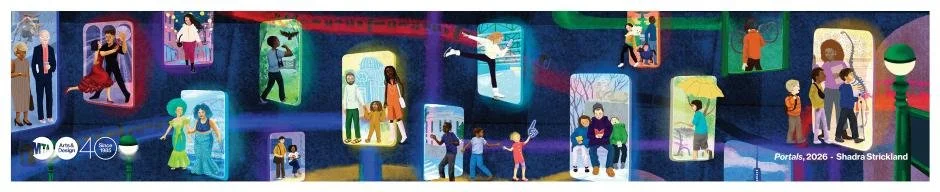
The subway car isn’t nearly as crowded as I expected, but almost everyone is looking at the same thing: their phone. A row of bowed heads stretches across the car as the 2 train races past 50th Street. Above them, sitting gracefully, hangs Shadra Strickland’s Portals (2026).
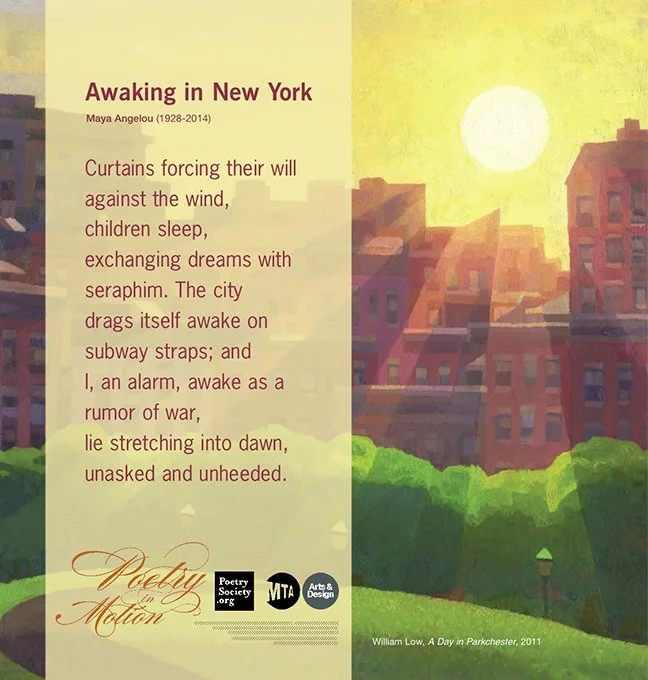
As a child in New York—before I knew of Oscar-Claude Monet or the inside of The Met—I knew that looking around certain stations and train cars meant discovering something beautiful. Murals and tiled pieces live on almost every walkway, particularly the maze of the 42nd Street station. I would sit near the train doors, reading whatever poems had been posted above the seats as I traveled between boroughs. In those lackluster morning rides, I first discovered the words of Maya Angelou through her poem “Awaking in New York,” with the background being William Low’s A Day in Parkchester to Angelou’s famous words. Whether I was searching for it or not, the city’s art always found me in the most unexpected place: underground.

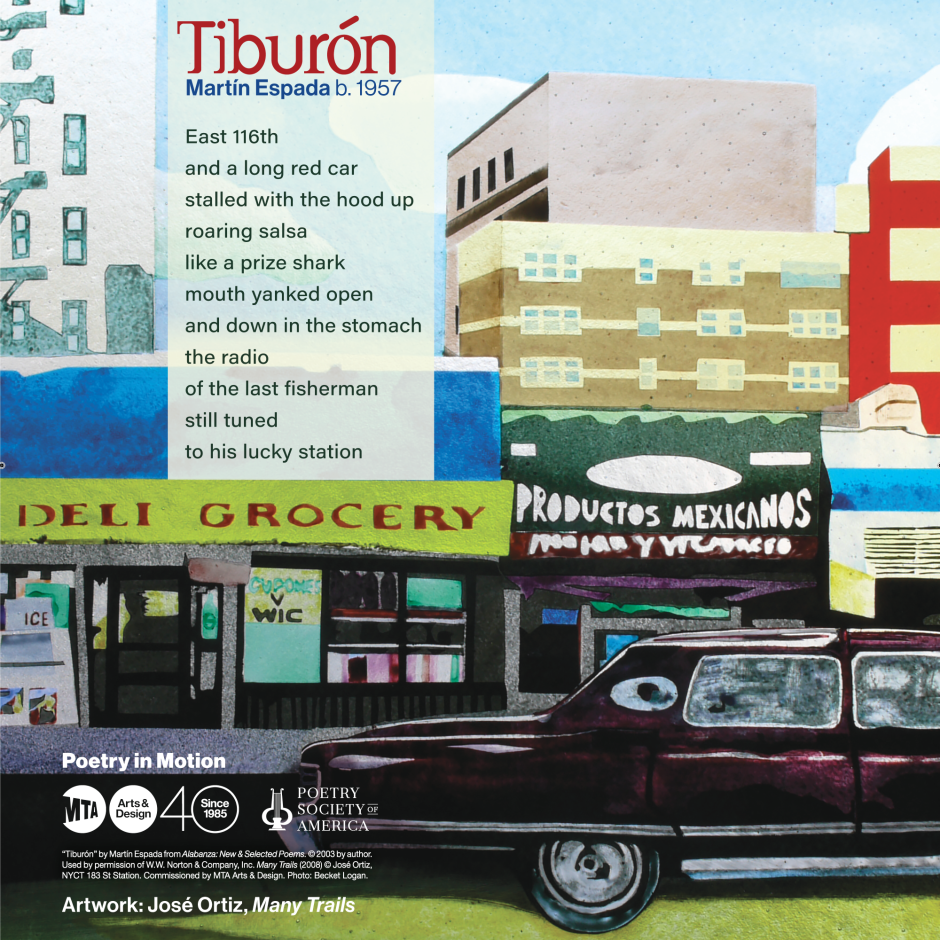
2012 was the first time I had seen poetry cards on the train after years of noticing the MTA hadn’t put up anything new. Today, “Tiburón”by Martín Espada graces the cars of the 1 train, alongside the artwork Many Trails by José Ortiz. It wasn’t until years later that I learned those poems I encountered on my morning rides were the work of Poetry in Motion, a program meant to cultivate beauty and artistry in New York’s subterranean world. Launched by the Poetry Society of America in 1992 in collaboration with the MTA, Poetry in Motion had only four initial poems in its repertoire: “Hope is the Thing with Feathers” by Emily Dickinson, “When You Are Old” by William Butler Yeats, “Let There Be New Flowering” by Lucille Clifton, and an excerpt from “Crossing Brooklyn Ferry” by Walt Whitman. After their four-year hiatus back in 2008, the program relaunched and reclaimed the corners of the subway cars they’d first accompanied me in, promising two new poems per quarter on both poster cards and digital screens. Poetry In Motion has expanded to over 30 cities across the country, bringing verse and rhyme into spaces that wouldn’t otherwise have it.
The MTA’s Art and Design agency, responsible for the photography, posters, music, and permanent art found throughout New York’s transportation hubs, celebrated its 40th anniversary in 2025. Portals, its newest artcard, asks commuters to notice their surroundings, to let art become a part of their commute rather than something to simply pass. I have stared at Portals each of my mornings on the train; I still find myself amazed at the way Strickland captured the essence of New York City’s subway system. Painted over a background of small trains, the piece features doors that open to various sites in New York: a dinosaur skeleton at the Museum of Natural History, a bicycle waiting to be ridden through the park, ice skating rinks, salsa dancing, nights out. It is everything I have experienced within the five boroughs of my city, captured and framed in the transit system that has carried me since childhood. I had the pleasure of speaking to Shadra Strickland, the artist behind Portals, about her experience working with the agency and the importance of public art in our world.
Ashley Gabriela: Could you tell me about how Portals became part of the MTA Arts & Design program? Was it created specifically for the program, or was it selected after it had already been completed?
Shadra Strickland: I was commissioned to complete the piece for MTA. They were aware of my work and invited me to create a piece for their Artcard program.
AG: What inspired Portals, and was there a particular feeling or message you hoped riders would take away from the piece, even if they only caught glimpses of it during their commute?
SS: I lived in New York from 2003 through 2009. Growing up in Atlanta, I wasn’t used to taking public transportation, so having to rely on it heavily in the city was new for me. I was amazed at how many different worlds you could experience off of one train fare! I hope that viewers can see a version of themselves in the piece and relate to the variety of locations that are highlighted. My favorite portal is the one with commuters carrying their pets in creative ways; New Yorkers are the best problem solvers.
AG: What was your experience collaborating with the MTA? Were there any unique challenges that you faced throughout the process?
SS: I sent in a few sketch ideas; the most challenging part of the assignment was the length! Figuring out a way to create flow and interest from one side of the page to the other was unique. Once I explained my idea to the art director, they were on board.
AG: Have you received any memorable reactions from commuters since the installation?
SS: Many people have messaged me on Instagram; I wasn’t expecting to connect with an audience—figuring people would just appreciate the work and keep moving—but so many have found me on social media to tell me how much they enjoy the work. Some even say that they see themselves in a particular character.
AG: Looking back at your career, did you ever imagine your work would become part of a program meant for the eyes of millions of New Yorkers? What does that mean to you as an artist?
SS: The artcard program always seemed so mysterious to me. I didn’t know if artists applied to create cards or if they were mysteriously chosen, so I had hoped I might create something at some point, but I never invested in the idea too much. I think I was most surprised that the invitation came years after living in New York City. It means so much to have thousands of people engage with the work. The gift of the MTA Arts program is that regular folks get to see amazing art in their everyday lives. So many think that art isn’t for them—which is the farthest thing from the truth.
AG: Do you have any favorite public art pieces of your own?
SS: They’re all so good! Derek Fordjour’s PARADE is delightful! My next authored book is titled “HERE COMES THE BAND,” and is about HBCU marching bands. Fordjour’s piece definitely captures that energy.
AG: Do you have any upcoming public art pieces, exhibitions, or other work you’d like readers to know about?
SS: I am primarily an illustrator of children’s books. You can check out my writing and illustrated book “JUMP IN!” which influenced the Portals piece.
It was enlightening to discover that artists like Shadra are sought out and commissioned to transform the city’s ordinary spaces into something more personal. It adds another defining layer to the artwork we encounter accidentally. Portals and the paintings inside a museum are both curated for the viewer, yet underground, it’s completely unexpected and inviting. One space asks us to enter, while the other meets us in the places we already find ourselves in. Shadra noted that many people think art isn’t for them. The MTA Arts & Design program proves that this ideology is far from the truth by democratizing culture and history underneath New York, implementing artistry within architecture and public transit. Not only does it allow the public to witness amazing art in their everyday lives, but it also raises an artist’s outreach, helping bring the work of creatives like Shadra to the everyday routines of millions.
As an adult, reading is one of my biggest passions. The first time I learned that reading didn’t have to be confined to school assignments was while on the train—in front of a Poetry In Motion poster. I don’t remember what the fare was when I was 10, but I do remember the subway’s art.
On my daily 9:05 a.m. train, a child sits near the doors, looking up at a poster of Martín Espada’s “Tiburón.
I wonder if he recognizes the familiarity of the neighborhood within the artwork. I wonder if the poem will stay with him as long as it has stayed with me since I first saw it.
I inch up in my seat, and I begin reading it again too.